The Cotswolds may be best known for rolling hills and picture-perfect villages, but look a little closer and you will find a landscape shaped by centuries of extraordinary engineering. Canal builders drove tunnels through solid oolitic limestone. Brunel pushed his Great Western Railway through the same hills a generation later. Ship captains deliberately grounded their vessels along the Severn to hold back the river itself. This is a region where ambition met geology, and the results are still visible -- and visitable -- today.
What follows is a guide to ten of the most impressive engineering works in and around the Cotswolds, from Georgian canal tunnels to Victorian viaducts, with practical details for anyone who wants to see them in person.
Sapperton Canal Tunnel
When the Thames and Severn Canal was completed in 1789, its crowning achievement was the tunnel at Sapperton. At 3,817 yards (3.49 kilometres), it was the longest tunnel of any kind in England, a distinction it held until 1811. The tunnel was built between 1784 and 1789, driven through the Cotswold limestone to connect the Stroud Valley with the Thames at Lechlade.
What makes Sapperton especially fascinating is the absence of a towpath. The tunnel was too narrow for horses, so boats were propelled by "leggers" -- men who lay on their backs on top of the narrow boats and walked their feet along the tunnel roof and walls. It was gruelling, claustrophobic work that could take several hours.
The tunnel is no longer navigable, but you can visit both portals. The eastern (Coates) portal is the more ornate, built in a classical style with a fine stone arch. The western (Daneway) portal is built in Gothic style with pinnacles and castellations, set in a wooded valley. A lovely walk of about two and a half miles along the old canal towpath connects the two. The Daneway Inn, a short walk from the western portal, makes a good stopping point. Access is free and parking is available at both ends.
Sapperton Railway Tunnel
Barely half a century after the canal tunnel was completed, Isambard Kingdom Brunel drove a second tunnel through the same ridge. The Sapperton Railway Tunnel, completed in 1845 for the Great Western Railway's Cheltenham and Great Western Union line, runs roughly parallel to its canal predecessor. Unlike the canal tunnel, this one remains in active daily use, carrying trains on the Golden Valley line between Swindon and Gloucester.
You cannot enter the railway tunnel, but you can see trains emerging from its portals, and the contrast between the two Sapperton tunnels -- one abandoned, one still thundering with traffic -- is a powerful illustration of how one transport revolution overtook another. The best vantage points are from the footpaths around Sapperton village, which also offer fine views across the Golden Valley.
Stanway Viaduct
The Stanway Viaduct is one of the most visually striking structures on the Gloucestershire Warwickshire Steam Railway. Built in 1903, this handsome viaduct carries the line across the valley on fifteen arches, stretching roughly 200 metres in length. It was constructed using Staffordshire blue brick, and its proportions are remarkably elegant for an Edwardian freight line.
The best news for visitors is that you can ride across it. The Gloucestershire Warwickshire Steam Railway operates heritage services between Broadway and Cheltenham Racecourse, and the train crosses the viaduct between Toddington and Winchcombe stations. Riding a steam train across this viaduct, with views across the Vale of Evesham, is one of the great railway experiences in the Cotswolds. Check the railway's website for timetables and fares -- services run primarily on weekends and during school holidays, with more frequent trains in summer.
Gloucester and Sharpness Canal
When the Gloucester and Sharpness Canal opened in 1827, it was the broadest and deepest ship canal in the world. Stretching 16.5 miles from Sharpness on the Severn Estuary to Gloucester Docks, it was built to allow sea-going vessels to bypass the most treacherous tidal stretch of the River Severn. The canal's dimensions are striking -- wide enough for large ships and lined with substantial swing bridges that still operate today.
Sharpness Docks remain operational, handling commercial cargo, and Gloucester Docks have been beautifully regenerated into a cultural quarter with the National Waterways Museum, restaurants, and shops. Walking or cycling the towpath between the two is a fine day out, flat and easy going, with birdwatching opportunities along the Severn Estuary. The canal is free to walk; the National Waterways Museum charges an admission fee.
Purton Hulks
This is one of the most haunting and unusual sites in the Cotswolds region. Between 1909 and 1965, eighty-six vessels were deliberately beached along the banks of the Severn at Purton to prevent the river from eroding the embankment between it and the Gloucester and Sharpness Canal. The result is the largest ship graveyard on mainland Britain.
The hulks include concrete barges, wooden trows, metal-hulled vessels, and even a pair of ferro-cement boats. Some are barely visible, absorbed back into the mud and vegetation. Others still show ribs and frames, rusting slowly into the landscape. It is an eerie, atmospheric place, especially at low tide when more of the wrecks are exposed.
Access is free and open at all times. A footpath runs along the canal embankment past most of the hulks, with interpretation panels identifying individual vessels. The nearest parking is at the Purton church or the Old Anchor Inn. Wear sturdy footwear -- the ground can be muddy.
Brimscombe Port
Brimscombe Port was once the most important inland port in the Stroud Valley, the Thames and Severn Canal's principal inland port, two miles east of Wallbridge where the canal met the Stroudwater Navigation. During the eighteenth and nineteenth centuries, this was a bustling hub of the wool trade, with warehouses, wharves, and a large turning basin where boats loaded and unloaded cargo.
The port fell into disuse after the canals declined, and by the twentieth century it was largely derelict. Today, a major restoration project is underway to revive the port as a mixed-use development centred on the restored canal basin. Even in its current transitional state, the site is worth visiting to appreciate the scale of the original engineering and to imagine the valley when waterborne trade was the lifeblood of the Cotswold textile industry. Access is free, and the surrounding towpath makes for pleasant walking.
Thames and Severn Canal Roundhouses
Among the most distinctive structures on any English canal are the five roundhouses built along the Thames and Severn Canal around 1790 and 1791. These circular cottages were homes for the lengthsmen, the canal workers responsible for maintaining their designated stretch of waterway. Each roundhouse is three storeys tall, built from local stone, and tapers slightly towards the top, giving them an almost fortified appearance.
Four of the five survive as Grade II listed private residences, though they are private residences and cannot be entered. You can see them from the canal towpath. The best-known are at Chalford (right beside the road through the village), Coates (near the eastern portal of Sapperton Tunnel), and Cerney Wick. They are a testament to the canal company's ambition -- even the workers' housing was built to last and built with style.
Bourton-on-the-Water Bridges
Bourton-on-the-Water is famous for its series of low, elegant stone bridges spanning the River Windrush as it flows through the centre of the village. The oldest dates from 1654, and the bridges collectively form one of the most photographed scenes in the Cotswolds. They are not grand engineering in the industrial sense, but they represent centuries of careful stonemasonry and a harmonious relationship between built structure and natural landscape.
The bridges are freely accessible at all times, and Bourton is well served with parking (pay and display), tea rooms, and pubs. The village can get extremely busy in summer, so an early morning or off-season visit will give you a more peaceful experience. While you are there, the Model Village includes a miniature recreation of the bridges, which is a charming and slightly surreal bonus.
Golden Valley Railway Line
The railway line from Swindon to Gloucester, often called the Golden Valley line for the stretch that follows the Frome Valley between Stroud and Sapperton, is one of the most scenic working railways in the Cotswolds. Engineered for the Great Western Railway and passing through Brunel's Sapperton Tunnel, the line winds through steep-sided valleys with views of the canal, old mill buildings, and wooded hillsides.
You do not need to be an engineering enthusiast to enjoy this -- simply catching a regular Great Western Railway service between Swindon and Gloucester gives you a window seat on a journey through the region's industrial and engineering heritage. Trains run frequently throughout the day. Kemble, Stroud, and Stonehouse are all stops along the route where you could break your journey for a walk.
Crickley Hill
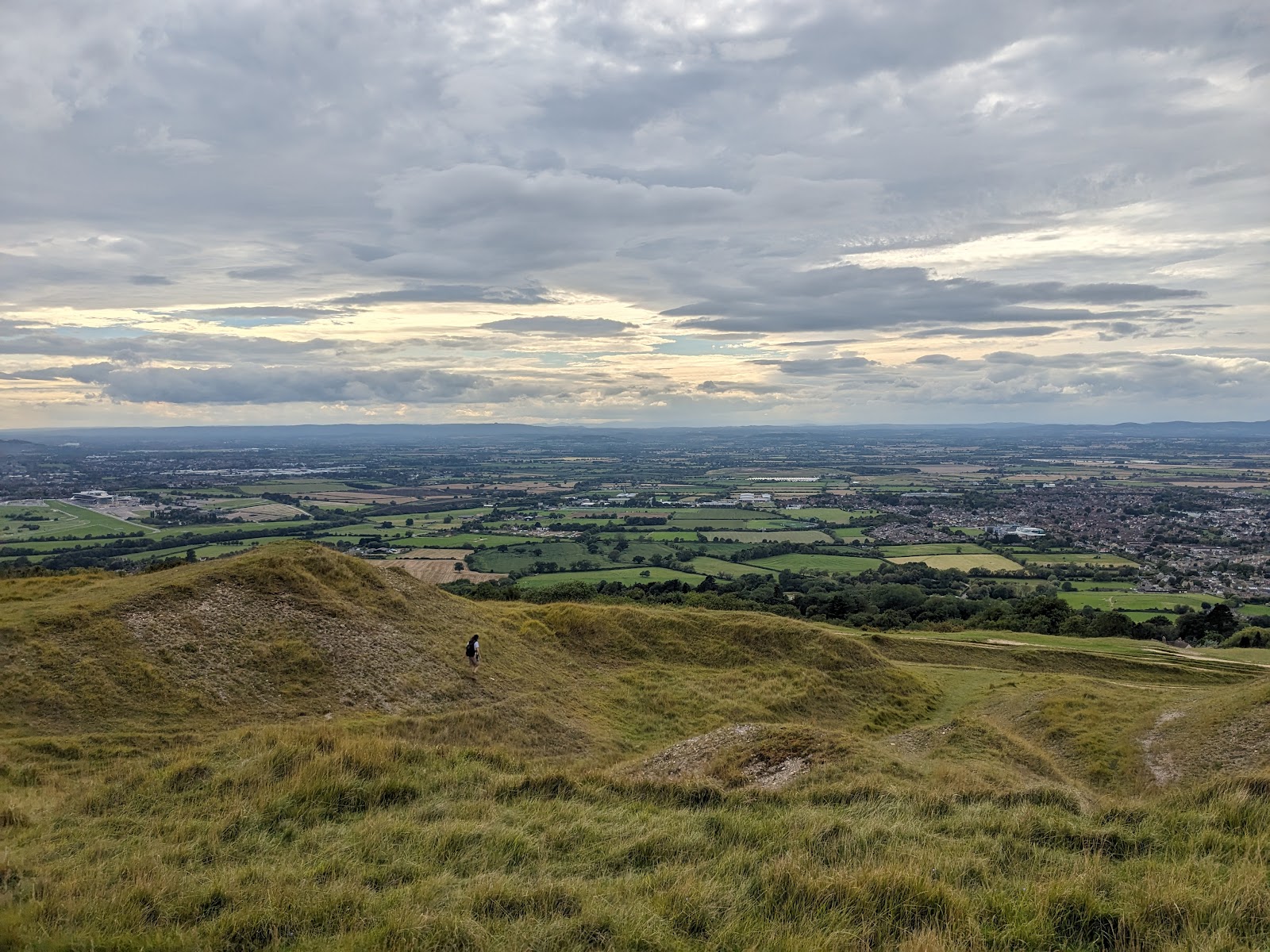
Crickley Hill sits on the western escarpment of the Cotswolds, overlooking Gloucester and the Severn Vale. While it is best known for its ancient earthworks -- Neolithic and Iron Age fortifications that represent some of the earliest large-scale engineering in the region -- it also offers a panoramic viewpoint from which you can see many of the other sites mentioned in this guide. The Severn Estuary, the line of the Gloucester and Sharpness Canal, and the distant ridges through which the Sapperton tunnels pass are all visible on a clear day.
Crickley Hill is managed by the National Trust and Gloucestershire Wildlife Trust. There is a car park (free for National Trust members, otherwise a small charge applies), and a network of footpaths crosses the site. The earthworks themselves are a humbling reminder that the urge to reshape the landscape is not a modern phenomenon -- people were engineering this hillside four thousand years before the canal builders arrived.
Planning Your Visit
Many of these sites can be combined into a day trip or a weekend itinerary. The Sapperton tunnels, roundhouses, and Brimscombe Port are all within a few miles of each other in the Stroud Valley. Purton Hulks and the Gloucester and Sharpness Canal work well as a separate outing, combined with a visit to Gloucester Docks. The Stanway Viaduct is best enjoyed as part of a steam railway trip from Toddington or Broadway.
Most sites are free to access and open year-round, though the steam railway operates a seasonal timetable. Good footwear is recommended for the canal towpaths and Purton Hulks, especially in winter. Ordnance Survey Explorer maps OL45 (The Cotswolds) and 179 (Gloucester, Cheltenham and Stroud) cover the area well for walkers.